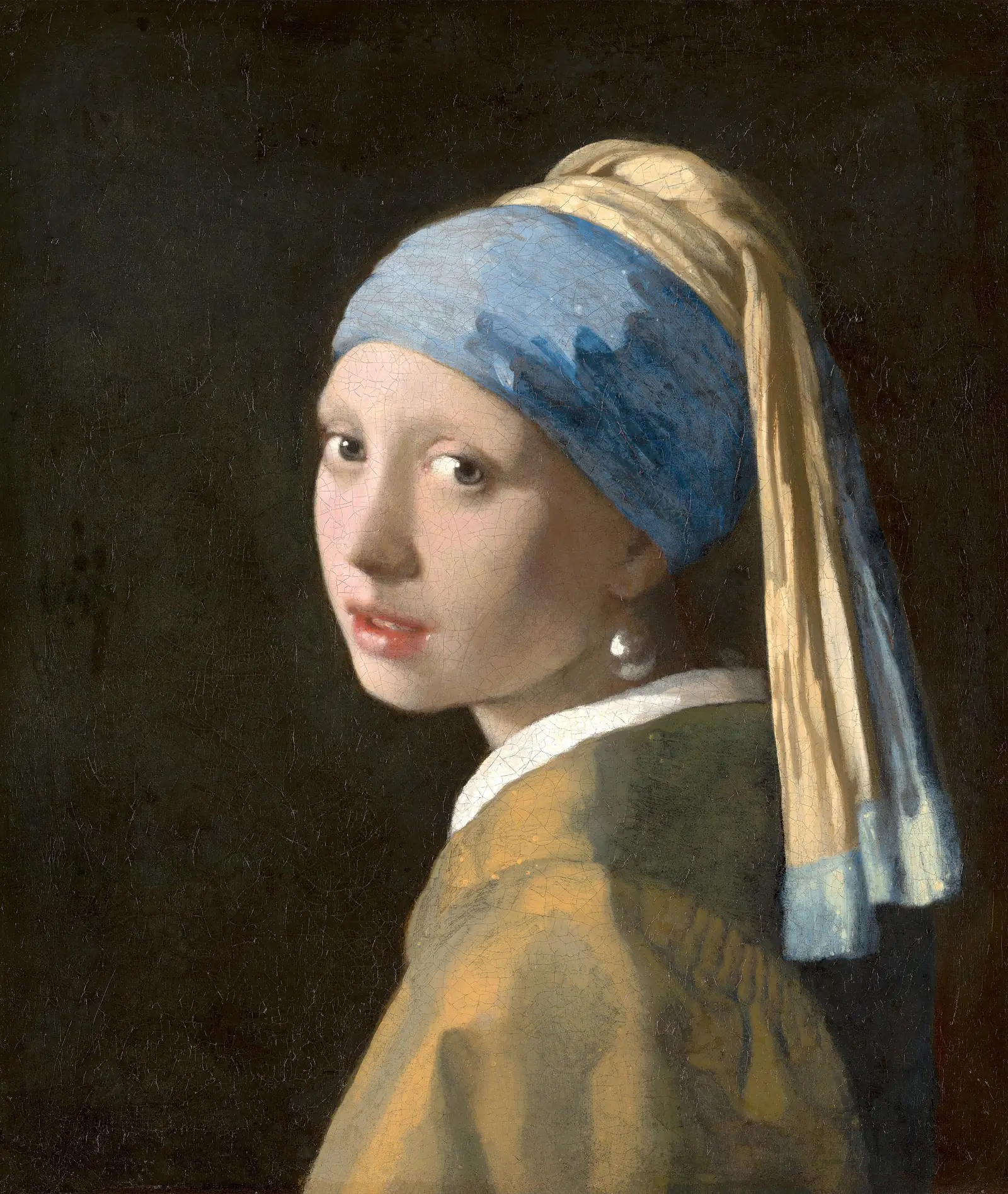
Eye shapes are described by four measurements: tilt, which tells whether the outer corner sits higher or lower than the inner one; opening, which compares the height of the eye with its width; the upper eyelid, which can be visible or covered by a fold; and the distance between the two eyes. Together, they say more than popular names like almond or round.
These measurements vary a lot from one person to another and from one population to another. None of them is a flaw, and none of them says anything about someone's character.
Eye tilt
It is the angle of the line that connects the inner corner to the outer corner of each eye. When the outer corner sits higher, the tilt is upward; when it sits lower, it is downward. The measurement is known as canthal tilt.
In an experiment with female faces, researchers increased the tilt in photos and asked people to choose between the original and the altered version. The version with increased tilt was chosen 93% of the time (Bashour and Geist, 2007). The study tested only women's faces and only the choice between two photos of the same face; it does not show that one tilt is the right one for everyone.
Eye opening
It is the relationship between the height and the width of the opening between the eyelids. A more open eye looks rounder; an eye that is wider than it is tall, with tapering corners, is what is usually called almond-shaped. Almond, round, and upturned are popular names, used in makeup and fashion, not measurement categories.
The upper eyelid
The eyelid can be fully visible, partly visible, or covered by a fold of skin that comes down over it, the eye known as hooded. Some people also have an epicanthic fold, a fold at the inner corner of the eye, more frequent in some populations than in others.
An eyelid that drooped suddenly, on one side only, or that came with weakness in the face, a severe headache, or double vision calls for medical care right away. Apart from that, the type of eyelid describes the eye; it is not a problem.
The distance between the eyes
It is measured between the inner corners of the two eyes. One classic rule says this space equals the width of one eye, and another says it equals the width of the nose. When the classic rules were tested on 153 young adults, equality with the width of the nose appeared in 40% of them (Farkas and colleagues, 1985). In other words, most people don't follow the rule, and that is normal.
In an experiment with photos, the distance between the centres of the eyes that made each face most attractive was about 46% of the width of the face, the measurement of an average face (Pallett and colleagues, 2010). Another study increased and decreased the distance between the inner corners in photos of 16 women: with a 10% increase, the faces were seen as more attractive and friendlier (Naran and colleagues, 2018).
What changes with ancestry
An international study of 1,470 adults from groups in Europe, the Middle East, Asia, and of African origin compared their facial measurements with those of a North American reference sample. The eye area showed the greatest variation between groups (Farkas and colleagues, 2005).
This means an eye measurement only makes sense compared with the person's own group. An epicanthic fold, an upward tilt, or wide-set eyes can be typical of one group and rare in another. None of them is a flaw, and a ruler designed for one group measures the others poorly.
Eye shape and personality
There is no basis for reading personality from eye shape. Studies show that people form impressions from features, like friendlier or more trustworthy, but forming an impression is not the same as being right. A study of more than a thousand executives tested the ratio between the width and height of the face, widely used to "read" behaviour, and found very little evidence that it predicts antisocial tendencies (Wang and colleagues, 2019).
What changes how the eyes read
- The eyebrows frame the eye, and their shape changes how your gaze reads. See eyebrow shape for face shape.
- Glasses change the apparent size of the eyes and the distance between them, through the width of the bridge and the shape of the frames. See how to choose glasses frames for your face shape.
- The photo. Up close, the camera changes the proportions of the face, and light from above casts shadows under the eyes. See why you look different in photos.
One eye slightly larger or higher than the other is common; see facial symmetry. To find out the shape of your whole face, go to how to find your face shape.
How Garbo assesses the eyes
In the Complete Transformation, the eyes are one of the 12 features. Garbo measures the opening, the tilt of the corners, and how much of the upper eyelid shows, and compares each one with the typical range for your group. It also describes the eyelid (exposed, moderate, or hooded), the distance between the eyes, the epicanthic fold, the visible white below the iris, the dark outline of the iris, the eyelashes, and dark circles.
The Style Guide includes the glasses frames for your face. The analysis describes the eyes as they are; it does not diagnose any vision or eyelid problem.
Frequently asked questions
What are the different eye shapes?
The popular names are almond, round, upturned, and hooded. The measurements that describe the eye are tilt, opening, eyelid type, and the distance between the eyes.
What is eye tilt?
It is the angle of the line between the inner and outer corners. With an upward tilt, the outer corner is higher; with a downward tilt, it is lower.
What are almond eyes?
That's the popular name for an eye that is wider than it is tall, with tapering corners. It is a makeup and fashion term, not a measurement category.
Are wide-set or close-set eyes a problem?
No. The distance between the eyes varies a lot between people and populations, and most people don't follow the classic rule.
Does eye shape say anything about personality?
No. People form impressions from features, but there is no basis for reading character from the shape of the face.
Want to see the measurements of your face? Take the free analysis: you answer a few questions, take a photo from the front, and see the real measurements of your face.
Sources
- Farkas LG e colegas (2005). International anthropometric study of facial morphology in various ethnic groups/races. Journal of Craniofacial Surgery.
- Farkas LG, Hreczko TA, Kolar JC, Munro IR (1985). Vertical and horizontal proportions of the face in young adult North American Caucasians: revision of neoclassical canons. Plastic and Reconstructive Surgery.
- Bashour M, Geist C (2007). Is medial canthal tilt a powerful cue for facial attractiveness? Ophthalmic Plastic and Reconstructive Surgery.
- Naran S, Wes AM, Mazzaferro DM, Bartlett SP, Taylor JA (2018). More Than Meets the Eye: The Effect of Intercanthal Distance on Perception of Beauty and Personality. Journal of Craniofacial Surgery.
- Pallett PM, Link S, Lee K (2010). New "golden" ratios for facial beauty. Vision Research.
- Wang D, Nair K, Kouchaki M, Zajac EJ, Zhao X (2019). A Case of Evolutionary Mismatch? Why Facial Width-to-Height Ratio May Not Predict Behavioral Tendencies. Psychological Science.

Now see what suits your face
Take the quiz and send a front-facing photo: the free analysis measures your face, shows its shape, and suggests haircuts and colours.
Start the free analysis